Average Directional Index (ADX)
Created by J. Welles Wilder, the Average Directional Movement Index (ADX) is part of the Directional Movement system (commonly referred to as DMI). This system includes the Positive and Negative Directional Indicators (+DI and −DI), the Directional Index (DX), and ADX, and is used to measure the strength of price trends. [Discuss] 💬
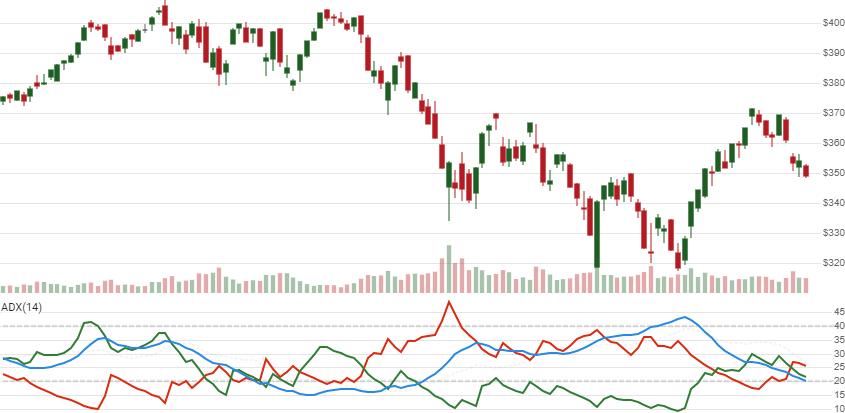
// C# usage syntax
IEnumerable<AdxResult> results =
  quotes.GetAdx(lookbackPeriods);
Parameters
lookbackPeriods int - Number of periods (N) to consider. Must be greater than 1. Default is 14.
Historical quotes requirements
You must have at least 2×N+100 periods of quotes to cover the warmup and convergence periods. We generally recommend you use at least 2×N+250 data points prior to the intended usage date for better precision.
quotes is a collection of generic TQuote historical price quotes. It should have a consistent frequency (day, hour, minute, etc). See the Guide for more information.
Response
IEnumerable<AdxResult>
- This method returns a time series of all available indicator values for the
quotesprovided. - It always returns the same number of elements as there are in the historical quotes.
- It does not return a single incremental indicator value.
- The first
2×N-1periods will havenullvalues forAdxsince there’s not enough data to calculate.
⚞ Convergence warning: The first
2×N+100periods will have decreasing magnitude, convergence-related precision errors that can be as high as ~5% deviation in indicator values for earlier periods.
AdxResult
Date DateTime - Date from evaluated TQuote
Pdi double - Plus Directional Index (+DI)
Mdi double - Minus Directional Index (-DI)
Dx double - Directional Index (DX)
Adx double - Average Directional Index (ADX)
Adxr double - Average Directional Index Rating (ADXR)
Utilities
See Utilities and helpers for more information.
Chaining
Results can be further processed on Adx with additional chain-enabled indicators.
// example
var results = quotes
    .GetAdx(..)
    .GetRsi(..);
This indicator must be generated from quotes and cannot be generated from results of another chain-enabled indicator or method.