Klinger Volume Oscillator
Created by Stephen Klinger, the Klinger Volume Oscillator depicts volume-based trend reversal and divergence between short and long-term money flow. [Discuss] 💬
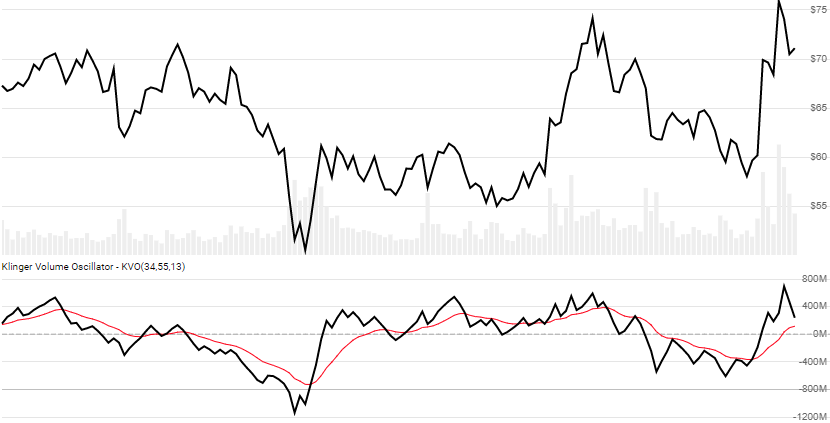
// C# usage syntax
IEnumerable<KvoResult> results =
  quotes.GetKvo(shortPeriods, longPeriods, signalPeriods);
Parameters
fastPeriods int - Number of lookback periods (F) for the short-term EMA. Must be greater than 2. Default is 34.
slowPeriods int - Number of lookback periods (L) for the long-term EMA. Must be greater than F. Default is 55.
signalPeriods int - Number of lookback periods for the signal line. Must be greater than 0. Default is 13.
Historical quotes requirements
You must have at least L+100 periods of quotes to cover the warmup and convergence periods. Since this uses a smoothing technique, we recommend you use at least L+150 data points prior to the intended usage date for better precision.
quotes is a collection of generic TQuote historical price quotes. It should have a consistent frequency (day, hour, minute, etc). See the Guide for more information.
Response
IEnumerable<KvoResult>
- This method returns a time series of all available indicator values for the
quotesprovided. - It always returns the same number of elements as there are in the historical quotes.
- It does not return a single incremental indicator value.
- The first
L+1periods will havenullvalues since there’s not enough data to calculate.
⚞ Convergence warning: The first
L+150periods will have decreasing magnitude, convergence-related precision errors that can be as high as ~5% deviation in indicator values for earlier periods.
KvoResult
Date DateTime - Date from evaluated TQuote
Oscillator double - Klinger Oscillator
Signal double - EMA of Klinger Oscillator (signal line)
Utilities
See Utilities and helpers for more information.
Chaining
Results can be further processed on Kvo with additional chain-enabled indicators.
// example
var results = quotes
    .GetKvo(..)
    .GetSlope(..);
This indicator must be generated from quotes and cannot be generated from results of another chain-enabled indicator or method.