ROC with Bands
Rate of Change (ROC) with Bands, created by Vitali Apirine, is a volatility banded variant of Rate of Change (ROC). [Discuss] 💬
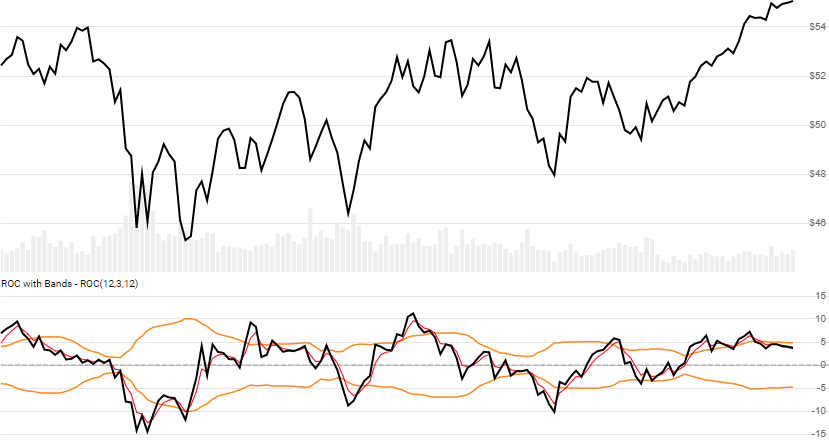
// C# usage syntax
IEnumerable<RocWbResult> results =
  quotes.GetRocWb(lookbackPeriods, emaPeriods, stdDevPeriods);
Parameters
lookbackPeriods int - Number of periods (N) to go back. Must be greater than 0. Typical values range from 10-20.
emaPeriods int - Number of periods for the ROC EMA line. Must be greater than 0. Standard is 3.
stdDevPeriods int - Number of periods the standard deviation for upper/lower band lines. Must be greater than 0 and not more than lookbackPeriods. Standard is to use same value as lookbackPeriods.
Historical quotes requirements
You must have at least N+1 periods of quotes to cover the warmup periods.
quotes is a collection of generic TQuote historical price quotes. It should have a consistent frequency (day, hour, minute, etc). See the Guide for more information.
Response
IEnumerable<RocWbResult>
- This method returns a time series of all available indicator values for the
quotesprovided. - It always returns the same number of elements as there are in the historical quotes.
- It does not return a single incremental indicator value.
- The first
Nperiods will havenullvalues for ROC since there’s not enough data to calculate.
RocWbResult
Date DateTime - Date from evaluated TQuote
Roc double - Rate of Change over N lookback periods (%, not decimal)
RocEma double - Exponential moving average (EMA) of Roc
UpperBand double - Upper band of ROC (overbought indicator)
LowerBand double - Lower band of ROC (oversold indicator)
Utilities
See Utilities and helpers for more information.
Chaining
This indicator may be generated from any chain-enabled indicator or method.
// example
var results = quotes
    .Use(CandlePart.HL2)
    .GetRocWb(..);
Results can be further processed on Roc with additional chain-enabled indicators.
// example
var results = quotes
    .GetRocWb(..)
    .GetEma(..);