Slope and Linear Regression
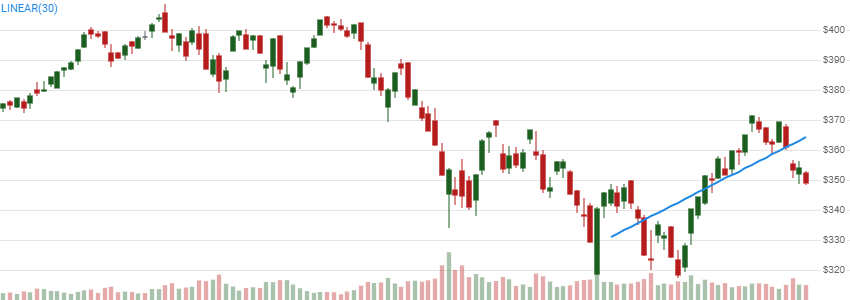
Slope of the best fit line is determined by an ordinary least-squares simple linear regression on price. It can be used to help identify trend strength and direction. [Discuss] 💬

// C# usage syntax
IEnumerable<SlopeResult> results =
  quotes.GetSlope(lookbackPeriods);
Parameters
lookbackPeriods int - Number of periods (N) for the linear regression. Must be greater than 1.
Historical quotes requirements
You must have at least N periods of quotes to cover the warmup periods.
quotes is a collection of generic TQuote historical price quotes. It should have a consistent frequency (day, hour, minute, etc). See the Guide for more information.
Response
IEnumerable<SlopeResult>
- This method returns a time series of all available indicator values for the
quotesprovided. - It always returns the same number of elements as there are in the historical quotes.
- It does not return a single incremental indicator value.
- The first
N-1periods will havenullvalues forSlopesince there’s not enough data to calculate. Linevalues are only provided for the lastNperiods of your quote history
👉 Repaint warning: the
Linewill be continuously repainted since it is based on the last quote and lookback period.
SlopeResult
Date DateTime - Date from evaluated TQuote
Slope double - Slope m of the best-fit line of price
Intercept double - Y-Intercept b of the best-fit line
StdDev double - Standard Deviation of price over N lookback periods
RSquared double - R-Squared (R²), aka Coefficient of Determination
Line decimal - Best-fit line y over the last N periods (i.e. y=mx+b using last period values)
Utilities
See Utilities and helpers for more information.
Chaining
This indicator may be generated from any chain-enabled indicator or method.
// example
var results = quotes
    .GetEma(..)
    .GetSlope(..);
Results can be further processed on Slope with additional chain-enabled indicators.
// example
var results = quotes
    .GetSlope(..)
    .GetRsi(..);